Search This Blog

Monday, June 24, 2013

Media Image Analysis


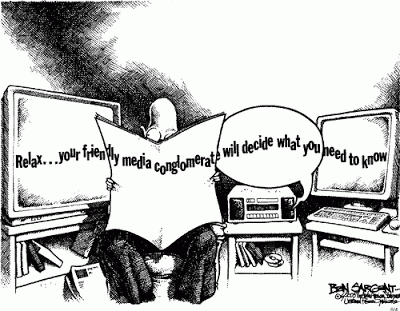
Provide an analysis for the following image. What is the message being conveyed? Up to what extent does it apply to your own reality as part of this “Global Village”

I believe the message is trying to say that when people watch the news they usually stay with the information that the media is giving them, they only know what the media wants them to know, they don't question if the media is really telling the truth or not, they don't investigate further more. As the text says, they are relaxed by knowing that the information they have is given by the media. The image shows someone locked up in his room, no color in the image, a sad image, and it appears he doesn't feel safe, he has one eye watching away, as if he was being cautious to something that could happen.  

Imrpove Writing & Paper 1

The Basics about Paper 1


  • Paper 1 asks students to produce a written commentary on one of two unseen texts within one and a half hour.
  • Pasages for analysis may be complete pieces of writing or extracts from larger works. There is also the possibility of commenting on a visual text or extract from a longer piece. Possible text-types for analysis include: advertisements, opinion columns, brochures, extracts from memoirs, or travel writing.
  • Each individual text is presented with two guiding questions.
  • The official Paper 1 counts for 25% of the final grade. It is assessed externally.


8 Ways to improve your writing"

Clauses at the beginning of a sentence: good idea, but avoid really long ones. 
There is nothing more boring than a series of sentences that all start with the subject of the sentence

Avoid 'it' as the subject of a sentence. 
Sentences that start with 'it' or dummy subjects, such as 'there is...' or 'there are...', are quite weak.

Use the right verb tense. 
This may come more naturally for native speakers of English. Nevertheless, many people make mistakes in the verb tense that they use. Be sure to know when to use each tense, such as the present simple, the present perfect, etc.

Use (relative) clauses. 
Using clauses in general is a good idea, as we saw in the first tip. Using relative clauses, which expand on ideas further (like this one), are also a good idea. Relative clauses make use of words such as 'which', 'who' and 'where'

Watch out for wordy sentences. 
It is good to read and reread your own work. Often times during self-evaluation, you see sentences that are not clear or 'run on'. Wordy sentences can be cleaned up with punctuation and parallel constructions (Tip 7).
Instead of: "If everyone in the building were to just clean up their own garbage and  if they  just sorted it properly then the recycle man wouldn't have to go through everything, then we wouldn't have to pay extra fees for this service."

Never start a sentence with 'But'. 
Although you may see sentences that start with 'But' in other works, you should avoid starting sentences with it for academic purposes.

Use parallelisms. 
Parallelisms are sentences or phrases that contain parallel syntactical structures. These usually contain lists of noun phrases or clauses with similar structure. For example: "I decided not to (1) use PowerPoint, (2) read notecards or (3) memorize a script." Notice how ideas 1-3 all contain a verb and an object. They all line up nicely in parallel.

Use active verbs.
In persuasive and academic writing and speaking, active verbs sound much stronger than passive verbs. Passive verb phrases use the verb 'to be' and the past participle of another verb. For example "The house was built by me." The active form of this phrase would be: "I built the house."

Written Task Planner


Idea Planner for Written Task 1 on Language and Mass Communication
Idea One:
Text type: Screenplay for a documentary

Topic: How did the creators of Facebook, some college boys managed to give an appropriate use to the media to get from a simple social network site to the most accessed network site ever.

Audience: Anyone who is interested in how Facebook started, and how it got from a simple page to the most accessed social network site.


Why this text type is appropriate to topic: It is going to be based on actual information, therefore it would not be appropriate for it to be an opinion. It could be based on an interview with the creator but as it is going to be a screenplay for a documentary, we can include actual information and a short interview with the creator.

Friday, June 7, 2013

Media Power on Society


1. What is Harold Laswell’s Chain of Communication’s Model? 
Who (speaker) says what (message) on which channel (medium) to whom (audience or listener) with what effect.
2. What does the theorist Marshall McLuhan’s mean by stating that “the Medium is the Message”? 
The media is the one that shapes and controls the scale and form of human association and action, therefor the media has the power to say whatever they want, either true or false, and make it believable for the audience. It has the ability to manipulate. The news can be real, but the way the media shows us the message is the real trick.
3. Refer to Jurgen Habermas’ “Public Sphere as a Platform for Advertising” 
We are all in the same sphere, media reveals information and many people may get it, and the ones who did not get it will probably get the information by friends of them. Sooner or later we all get the information.
4. What is the connection between Self-Presentation & the Celebrity Image?
Because of the women they use in advertisement, mostly celebrities, women who are thin are consider to be beautiful, and if those beautiful celebrities have talent then it is consider to be successful. 

Sunday, May 12, 2013

Are violent video games the main cause leading to real violence?

Many of today's brutal murders and massacres come from very young people, people who are still in high school, students or friends we would never think capable of doing such a thing. So what is it that all these killers have in common? The main answer is that they all played violent video games.

Such is the case of 17 years old Eric Harris and 18 years old Dylan Klebold. On the morning of April 20, 1999, both of these young men walked into Columbine High School and shot to death 12 fellow students and a teacher. Friends who survived the attack said that both of them liked playing video games, and spent a lot of time playing them. Both young men ended killing themselves that same day in the school.

For a more recent case, we have James Holmes, the man who entered a movie theater and killed 12 people. Same as Eric and Dylan, friends of James said that he played a lot of video games.

Studies show that 69% of the American population play video games, and 60% of those play violent video games. So how is it that few of them lead to real violence and others just keep playing the game. If people believe video games are the main cause leading to violence, then why is it that some are killers and others are not?

I believe it is not completely because of the video games, it is the combination of Risk Factors and Violent video games that lead people to real violence. Eric, Dylan and James were having other sort of problems in their life's. Eric and Dylan were bullied during high school. James had girlfriend and money issues. "Not every kid that plays a violent game is going to turn to violence. And that's because they don’t have all of those other risk factors going on"

As I mentioned, Dylan, Eric and James had risk factors going on, and by combining these with violent video games, they increased their aggressive thoughts and emotions. People who turns to real violence often have plenty risk factors and very few protective ones. Risk factors are considered "problems" in someone's life, such as mental disorders, particularly mood disorders, schizophrenia, anxiety disorders and certain personality disorders, alcohol, hopelessness, impulsive or aggressive tendencies, history of trauma or abuse, major physical illnesses, job or financial loss, loss of relationship, lack of social support and sense of isolation.

Sunday, April 14, 2013

Thursday, April 4, 2013

Advertising

“Advertising is everywhere you look, whether it is in the newspaper you pick up daily or on that billboard you see while driving down the highway. Some people may say that they are not in fact influenced by the advertising that is thrown at them each day, and that they do not fall into it, but everyone does.”

This text is telling us that it doesn't matter where you look, there will always be advertising there, it is always present, and I think this is true. Maybe we don't notice that the advertisements are there, but it's because we are used to seeing them every day, And it's not that we don't notice them because they don't call our attention, it's just that seeing the ad doesn't make it any more special because of we are used to seeing them, but you are still influenced by them in many ways. For example, if you see some red plastic chairs, or a red sunshade or even a red truck, you will probably think its from Coca-Cola, and it is because you are influenced by them, you are used to seeing so many ads of Coca-Cola so that every time you see something red you will think of the product. The advertising may appeal to an emotion and you will be influenced and may not notice it, you may think we are all different, and we think different, but in some cases, a color, a shape, or a phrase, triggers the same emotion in every one of us. Ads can also change how we see people who we don't really know, we may stereotype them from a previous advertisement we saw. 

Friday, March 15, 2013

TV commercials Analysis


The ad I chose to analyze is trying to sell the famous "Doritos", the commercial is set a man's house, but it also shows the neighborhood where he lives in, and where he buys something essential to the ad. There are not many people or animals in the commercial, we have the protagonist, a man who sold a Goat to the protagonist, and the Goat. The ad shows the Doritos at all time, it also shows a architectural model which the protagonist is working on, a picture of the protagonist and a Goat 4 Sale sign.

The ad begins with the protagonist taking a walk while eating some Doritos, something got his attention, it is a man sitting on a chair with a sign that says he is selling the goat next to him, which is also eating Doritos. The protagonist seems happy and surprised about this, and decides to buy the goat. The next scene places him and the goat in the kitchen, both eating Doritos. We can see a great difference between the protagonist emotions now and when the ad just started. At the beginning he didn't seem so happy, like something or someone was missing in his life, but when he is eating and spending time with the goat he looks very happy. 
The next scene is when the man is showing the goat where all the Doritos in the house are, for both of them.
Later the protagonist is working, while the goat is chewing the doritos very loud, which seems to annoy the protagonist, we later see the protagonist trying to sleep, but is annoyed again with the constant noise the goat is doing while chewing. We skip to a scene where the goat is yelling, and the reason is because there are no Doritos.
The goat immediately breaks a picture and the architectural model the protagonist was working on. The goat decides to go find the protagonist, and he is with all the Doritos inside a room writing Goat 4 Sale. The commercial ends with the goat closing the door of the room full with Doritos, in a way showing that the protagonist will be punished. With this we go back to the man selling the goat in the first place, which is wearing a orthopaedic neck, and has a pair of crutches next to him. This tries to tell us that the goat doesn't matter who is its owner, it only cares that the owner is feeding him Doritos.

The audience for the ad is almost everyone, as it is a type of food, it can be for anyone, but if i had to pick some age, i would say teenagers, because they are the ones who like eating chips and food like that. I believe the ad is trying to tell you that you must care that you have Doritos. The sound effects of this ad change the meaning, the music is the same, but in one part the music is interrupted  in a way that something is wrong, then a dramatic sound at the ending, to show something bad is going to happen. The ad doesn't have any celebrity, just a regular man who lives by himself. I don't think the ad is breaking any law, in the US, the  Federal Trade Comission is in charge of the policies and laws of advertisement, its very difficult that the ad broke any law because it was the winning ad of the super bowl.